
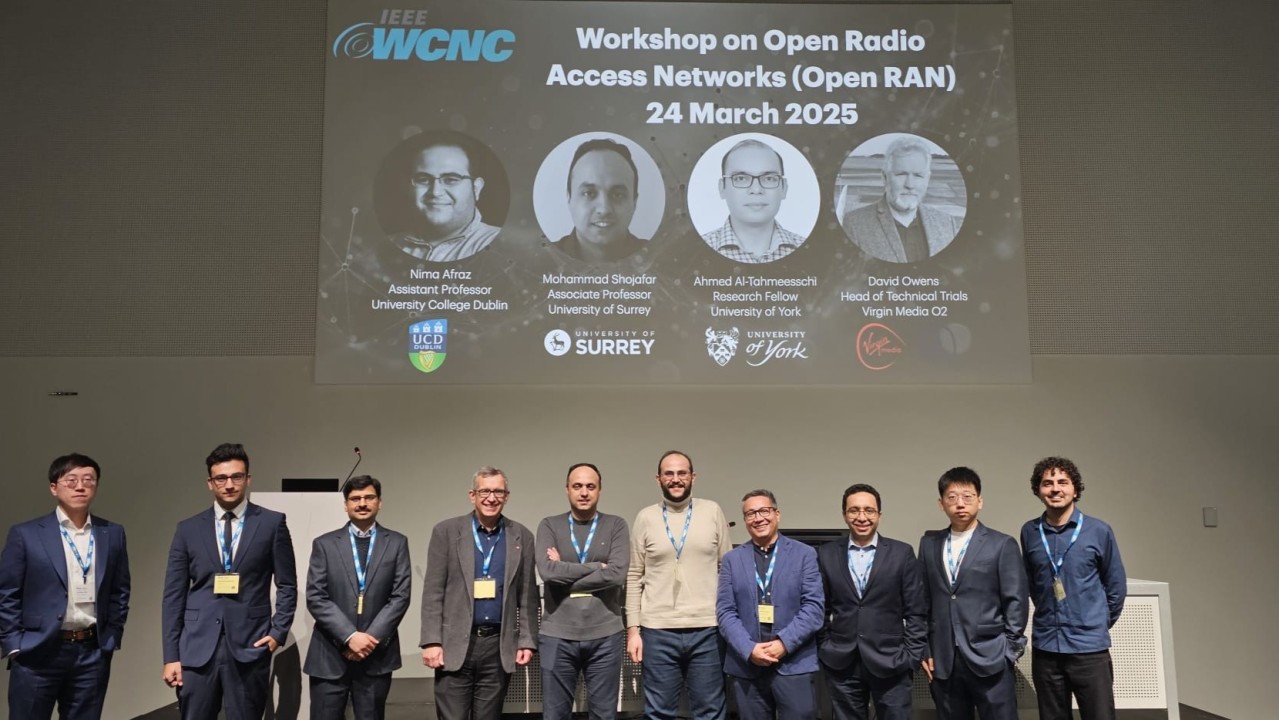


Workshop Organisers:
- Nima Afraz (UCD, Ireland)
- Mohammad Shojafar (Surrey, UK)
- Ahmed Al-Tahmeesschi (York, UK)
- David Owens (Virgin Media O2)
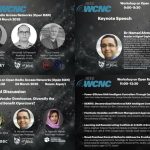
Session 1: Keynote – “Machine Learning in Open RAN, Opportunities, Challenges and the Way Forward”
🎤 Dr. Hamed Ahmadi, University of York, UK

Dr. Ahmadi’s keynote set the stage by addressing how modern AI/ML can transform Open RAN. Key points:
- Open RAN Motivation: Break vendor lock‑in, disaggregate hardware/software, foster innovation.
- ML & Digital Twins: Virtual network replicas for simulation, monitoring, optimisation (projects: YO‑RAN, REACH, ORAN‑TWIN).
- AI/ML Use Cases: energy saving, traffic steering, QoS prediction, anomaly detection.
- Collaborative Research: Green, secure, privacy‑aware wireless – from rural broadband to smart digital platforms.
Session 1: Interactive Panel Discussion
Topic: “Can Open RAN Break Vendor Dominance, Diversify the Market, and Benefit Operators?”
Panel Chair: Dr. Nima Afraz, University College Dublin
Panelists: Fatemeh Afghah (Clemson), Hamed Ahmadi (York), Johann M. Marquez-Barja (imec/UA), Waqas Bin Abbas (Bristol).

The discussion was structured around several key questions:
1. How do vendors, operators, and regulators currently perceive Open RAN?
Highlights: Diverse perspectives – interest but interoperability concerns. In multi‑vendor scenarios, pinpointing performance issues becomes complex. Johann Marquez‑Barja proposed an orchestrator to oversee xApps and ensure accountability.
2. What are the key lessons from early Open RAN deployments?
Highlights: Interoperability and conflict mitigation challenges; diluted accountability; importance of data‑driven insights; innovation vs. management complexity.
3. Are you optimistic about near‑term wide‑scale adoption of Open RAN?
Highlights: Cautious optimism – political push for competition, but technical hurdles remain (conflict mitigation, standards). Incremental adoption likely.
4. How to avoid creating “islands of interoperability” in Open RAN deployments?
Highlights: Universal interoperability is an ideal; small clusters may be inevitable. Policy coalitions and consortia can bridge islands. Orchestrators again seen as key to harmonisation.
Session 2: Open Radio Access Networks – Technical Presentations
Chair: Dr. Nima Afraz, University College Dublin
- Power‑Efficient RAN Intelligent Controllers Through Optimized KPI Monitoring – Lima, Katsaros, Nikitopoulos (Surrey, UK)
- DERRIC: Decentralized Reinforced RAN Intelligent Controller Orchestration for 6G – Hashemi Nezhad, Di Maio, Braun (Bern, CH)
- FlexScale: Scalable Management for Near‑RT RIC in O‑RAN – Kumar, Zitouni, Akbas, Foh (Surrey & London Met, UK)
- Learning and Reconstructing Conflicts in O‑RAN: A Graph Neural Network Approach – Zolghadr, Santos, DaSilva, Kibiłda (Virginia Tech, USA & TCD, IE)
- Novel Fronthaul Control Method to Address the Fronthaul/Air Interface Tradeoff – Larrañaga‑Zumeta, Villegas, Koutlia, Diez, Aguero, Lagen (CTTC & UC, Spain)
Key Takeaways & Future Directions
- Interoperability & Orchestration: Need for robust frameworks and orchestrators to manage multi‑vendor ecosystems.
- Data‑Driven Optimization: ML and digital twins promise operational efficiency and energy savings.
- Incremental Adoption: Universal interoperability is aspirational; consortia and standardised interfaces are pragmatic.
- Collaborative Ecosystem: Continuous cooperation among vendors, operators, regulators, and researchers is vital.