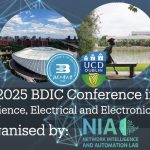

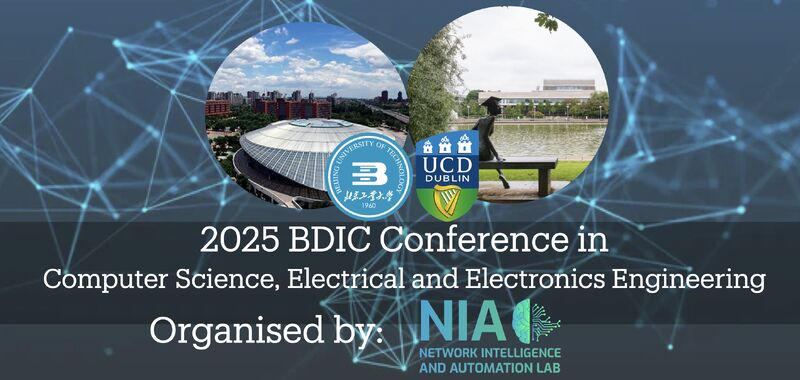
The second BDIC Conference was held on 26 November 2025 at Beijing University of Technology (BJUT), organised by the UCD Network Intelligence and Automation Lab (NIA). The event brought together researchers and students from UCD and BJUT, with strong growth in participation this year: posters increased from 15 to 24, and undergraduate submissions from one to five.
Research was presented across four tracks, and sessions encouraged collaboration and discussion between both institutions. The Best Poster Awards were selected by the Technical and Awards Committee: Dr Aidan Murphy, Dr Mohamed Saadeldin, Dr Pasika Ranaweera, Dr Dr. Anca Delia Jurcut, and Dr Arjun Pakrashi. Awards were made in undergraduate and postgraduate categories.
• Best Undergraduate Poster: Li Junhao
• Best Poster: Yanlei Hu
• Best Poster: Eranda Jayatunga
The conference was chaired by Dr Nima Afraz with Dr Pasika Ranaweera as co-chair, and opened by Dr. Ailish O’Halloran. We thank Principal Lishan Sun, Prof. Wu Wenying, Prof. Paul Fanning, Dr Neil Hurley, Vice Principal Sun Enchang, and Prof. O’Halloran for their support.
About NIA
UCD Network Intelligence and Automation Lab (NIA) at University College Dublin researches intelligent and autonomous network systems, focusing on Open RAN conflict mitigation, satellite resource sharing, and blockchain-assisted automation. The lab is involved in major funded projects including NSSPI (€7.9M, Enterprise Ireland/DTIF), RE-ROUTE (€671.6K, European Commission), and Data-Driven xApps Conflict Management (Research Ireland CONNECT Centre).
More at: https://nia.ucd.ie